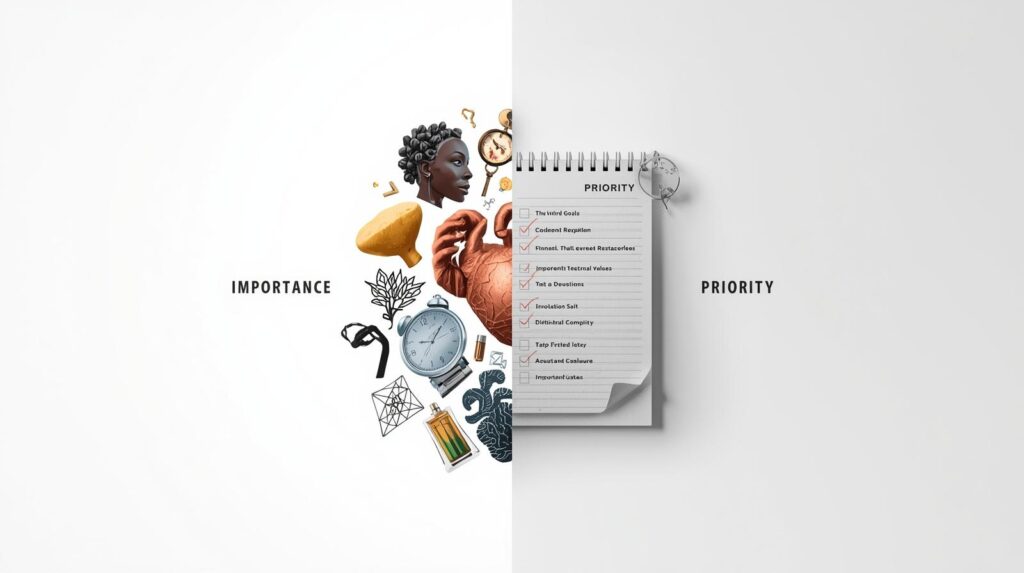

People often use the words importance and priority as if they mean the same thing. In daily conversation, at work, and in planning, these terms are mixed without much thought. This confusion leads to stress, missed goals, and poor use of time. Understanding the difference between importance and priority helps people make clearer decisions and manage responsibilities with less pressure.
Importance and priority are related but not identical. One describes value, while the other describes order. When people separate these ideas, they gain control over focus and action. This article explains the difference between importance and priority, how they interact, and why mixing them causes problems.
Understanding Importance
Importance refers to value. Something is important when it holds meaning, impact, or relevance to a person’s life, goals, or responsibilities. Importance answers the question of why something matters.
Importance is often tied to long-term outcomes. Health, income stability, learning, relationships, and safety are common examples of things people consider important. These areas affect life quality and future conditions.
Importance does not demand immediate action. Something can be important even if it does not require attention right now.
Understanding Priority
Priority refers to order. Something is a priority when it needs attention before other things. Priority answers the question of what should be done first.
Priority is often shaped by time limits, urgency, and deadlines. Tasks with close deadlines or immediate consequences usually become priorities.
Priority changes often. What is a priority in the morning may not be a priority at night. Priority is dynamic and responsive to situations.
The Core Difference Between Importance and Priority
The main difference lies in purpose. Importance defines value. Priority defines sequence.
Importance is about significance. Priority is about timing.
Something can be important but not a priority at the moment. Something can be a priority without being important in the long term.
Understanding this difference prevents confusion in decision making.
Examples That Clarify the Difference
Health is important, but a medical checkup scheduled months away may not be a priority today.
Replying to an email may be a priority because of a deadline, but it may not be important in the long run.
Saving money is important, but paying a bill today becomes the priority.
These examples show how importance stays stable while priority shifts.
Why People Confuse Importance and Priority
Confusion happens because both concepts influence action. People feel pressure to act quickly and assume urgency equals importance.
Modern life rewards fast responses. Notifications, messages, and deadlines push tasks into priority positions, even when their importance is low.
This constant urgency trains people to react instead of reflect.
Urgency Versus Importance
Urgency often drives priority. When time is limited, tasks move to the front.
Importance does not always involve urgency. Some important things improve life slowly over time.
When urgency dominates decision making, important tasks are often delayed. This leads to regret and imbalance.
Learning to separate urgency from importance improves focus.
How Importance Shapes Long-Term Direction
Importance sets direction. It influences goals, values, and long-term planning.
People choose careers, relationships, and habits based on what they find important.
Even when priorities change daily, importance acts as a guide that keeps decisions aligned.
Without clarity on importance, priorities become reactive rather than intentional.
How Priority Shapes Daily Action
Priority controls daily behavior. It decides which task is done next.
Priority helps manage limited time and energy. Without priority, everything feels equally demanding.
Effective priority setting reduces overload by limiting focus to a manageable number of tasks.
Priority is a tool for execution.
The Risk of Treating Everything as a Priority
When everything is treated as a priority, nothing receives full attention.
This leads to stress, mistakes, and fatigue. People jump between tasks without progress.
Treating low-importance tasks as priorities drains energy from meaningful work.
Clear distinction prevents overload.
The Risk of Ignoring Importance
Focusing only on priorities can cause long-term neglect.
People may complete urgent tasks while ignoring health, learning, or planning.
Over time, ignored important areas create problems that demand urgent attention later.
Balance requires attention to both importance and priority.
Importance Without Priority
Some things remain important but receive no action because they lack urgency.
Examples include exercise, skill development, and relationship building.
These areas improve life gradually, but without priority placement, they are postponed.
Intentional scheduling helps turn importance into action.
Priority Without Importance
Some tasks become priorities because of external pressure rather than value.
Examples include unnecessary meetings or excessive communication.
These tasks consume time without contributing to goals.
Reducing these priorities frees space for important work.
Decision Making Using Importance and Priority
Good decisions require evaluation of both concepts.
First, identify importance by asking how the outcome affects life or goals.
Second, assign priority based on timing and constraints.
This two-step approach improves clarity.
Importance and Priority in Work Life
In work environments, importance aligns with outcomes and responsibility.
Priority aligns with deadlines and workflow.
Problems arise when urgent tasks replace meaningful work.
Clear communication helps teams align priority with importance.
Importance and Priority in Personal Life
In personal life, importance reflects values and relationships.
Priority reflects daily demands.
Without reflection, personal priorities may be driven by habit rather than intention.
Regular review helps maintain balance.
Time Management and the Difference Between Importance and Priority
Time management improves when people separate importance from priority.
Lists should include both categories.
Important tasks should be scheduled before urgency forces action.
This reduces stress and increases control.
How Values Influence Importance but Not Always Priority
Values define what matters deeply.
However, values do not always create urgency.
This gap explains why people struggle to act on what they value.
Bridging this gap requires planning.
External Pressure and Priority Distortion
External demands can distort priority.
People may feel obligated to respond immediately even when value is low.
Learning to say no protects important areas.
Priority should not be controlled entirely by others.
Importance, Priority, and Responsibility
Responsibility increases both importance and priority.
When outcomes affect others, tasks gain weight and urgency.
Clear roles help define both concepts accurately.
Adjusting Priorities Without Losing Importance
Priorities must shift based on reality.
However, shifting priority does not mean abandoning importance.
Short delays are acceptable. Long neglect is not.
Awareness prevents loss of focus.
How to Align Priority With Importance
Alignment requires planning and review.
Important tasks should appear regularly in priority lists.
Small actions reduce resistance.
Consistency builds progress.
Teaching the Difference Between Importance and Priority
Understanding this difference improves communication.
Clear language reduces conflict and confusion.
Teams and families benefit from shared understanding.
Long-Term Impact of Clear Distinction
People who separate importance from priority experience less stress.
They make decisions with intention rather than reaction.
They protect what matters while handling what demands attention.
This clarity improves life balance.
Final Thoughts on Importance and Priority
Importance defines what matters. Priority defines what comes first. Both are necessary, but they serve different roles. Confusing them leads to stress and misplaced effort. Separating them leads to clarity and control.
By understanding this difference, people can manage time better, reduce pressure, and focus on what truly shapes outcomes.